
Data Sharing Across the Value Chain Is Key for Quantifying Industry Emissions

Most companies focus on reducing emissions they directly control, yet the majority of emissions often occur outside their own operations. As large producing companies seek to quantify and reduce total value chain emissions, upstream actors are pushed to provide emissions data, requiring transparency and collaboration.
Emissions extend beyond company borders
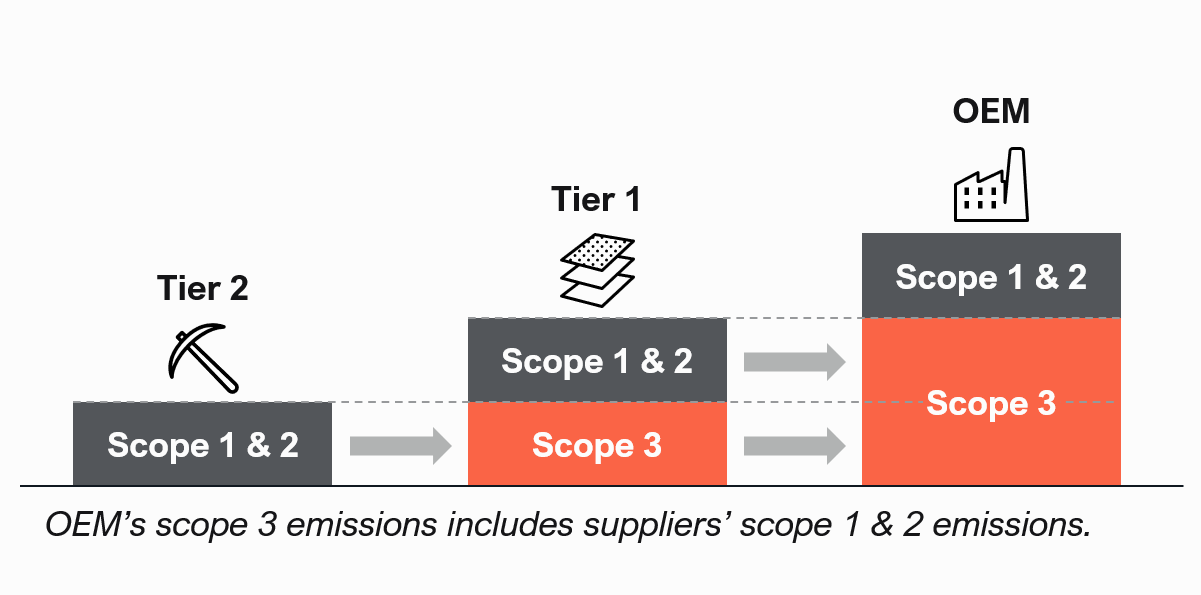
Emissions reporting is guided by standards, e.g. the GHG Protocol which includes all value chain emissions divided into three scopes: 1, 2, and 3. Until now, companies have mainly focused on emissions they directly control (scope 1 & 2), however indirect up/downstream emissions (scope 3) often make up the majority of total emissions.
“Scope 3 upstream can represent up to 70% of a company’s emissions...”
— World Economic Forum, 2023
New emissions reporting demands
Hence, large downstream actors (e.g. OEMs), previously focusing on scope 1 & 2 emissions, are now looking to accurately report scope 3. This demands suppliers to start reporting their scope 1 & 2 to feed into OEMs’ scope 3. For many suppliers, the demand for emissions reporting is new, and poses challenges to collect and organize data.
The challenges of value chain data sharing
One challenge is that downstream actors request emissions data in different formats and types. The lack of cross-industry standardization results in increased workload for suppliers and requires OEMs to interpret inconsistent data. Furthermore, many suppliers are hesitant to share their data with external actors as they see a risk without clear business value. Together, these factors complicate scope 3 reporting, which fundamentally depends on effective sharing of data that is not always readily available from the suppliers.
Reaching net zero demands collaboration
To overcome these challenges, some organizations are forming cross-industry partnerships to standardize trusted fact-based data sharing. Over time, decision-grade data provides visibility and clarity enabling informed customer decisions that are key to reducing total value chain emissions. This development can serve as a catalyst for meaningful climate action across industrial value chains.

